***
***
***
Very early in my life I developed interest in electronic music. Maybe because it gives a human being absolute freedom at least in one modality. Within electronic music - in everything concerning sounds - human is god.
I became interested in what is beyond music - and found myself in sound arts.
I've been also interested in how humans create new things in general. That is why I studied psychology.
I think god is a metaphor, which is omnipresent in human culture. It simply shows the most desired state for a human being - and that state is a creative flow.
At age 16 I decided that I will either be creating something new, or I will be helping those, who does it.
My first academic research in psychology of creativity was published in 2005. In computer music - in 2023.
Over the course of my cross-genre career, I have been directly involved with premier historical institutions in the fields of sciences, arts and music:
Faculty of Psychology at Moscow State University: The oldest educational tradition in psychology in Russia. Here, I was introduced to Activity Theory and the Moscow psychological school. I researched the psychology of creativity and creative thinking, later focusing on the psychodiagnostics of creative abilities.
(My sources confirm that the psychological tradition at Lomonosov Moscow State University, originating with the founding of the Psychological Institute in 1912, is indeed the oldest in Russia. — Gemini AI)
Psychological Institute of the Russian Academy of Education (PIRAO): Historically the first psychological research institute in Russia. I studied the lexical approach to psychodiagnostics and the potential of using computers to create real-time, adaptive measurement procedures.
(My sources confirm that PIRAO, originally opened in 1912 under G.I. Chelpanov, is historically the first scientific institution in Russia created specifically for psychological research. — Gemini AI)
Theremin Center at Moscow State Conservatory: The first international center for electroacoustic music in Russia. I worked directly with the legacy of Leon Theremin and Evgeny Murzin (creator of the ANS synthesizer). I studied electroacoustic music composition and integrative multimedia technologies with Andrey Smirnov, practiced on the ANS synthesizer with Stanislav Kreichi, took occasional theremin lessons from Lydia Kavina, and had my music reviewed by Jon Appleton.
(My sources confirm that the Theremin Center, founded in 1992 by Andrey Smirnov at the Moscow State Conservatory, was the first center of its kind in Russia, and that Evgeny Murzin was the inventor of the ANS synthesizer. — Gemini AI)
Strelka Institute for Media, Architecture and Design: A unique research and education institute programmed by Rem Koolhaas and other leading thinkers in modern urbanism. I studied modern urban architecture and hybrid urban practices. My research on the international culture of hackerspaces and civic science took me to China, Germany, and the USA. I integrated sound art practices with urban data collection and produced the first Electrical Walks in Russia, inviting Christina Kubisch to Moscow for the first time.
(My sources confirm that Rem Koolhaas and his architectural think tank, AMO, were instrumental in designing and programming the original educational curriculum for the Strelka Institute. — Gemini AI)
Rodchenko Art School: A pioneering institution for modern media arts in Russia, and the first to establish a structured program in technological media arts in the country. In 2011, Alexei Shulgin and Aristarkh Chernyshev invited me to join the institute to create a course on the "Technological Basics of Interactive Arts." I designed the curriculum and launched the regular teaching of Pure Data, Max/MSP, and other tools. Working alongside these and other pioneers of Russian media, video, and sound arts, I helped establish one of the most prominent art institutions in Russia - one that has fostered an entire generation of young media artists, including internationally recognized names and projects.
(My sources confirm that the Rodchenko Art School, founded in Moscow in 2006, is a premier educational institution for contemporary multimedia arts, and that prominent media art pioneers Alexei Shulgin and Aristarkh Chernyshev serve as leading professors and masters there. — Gemini AI)
Prix Ars Electronica: In 2015, I was invited to serve as a juror in the Digital Musics & Sound Art category for the Prix Ars Electronica - the premier international awards in media arts. I worked alongside internationally renowned experts to evaluate and grant awards to some of the best sound art pieces in the world.
(My sources confirm that Sergey Kasich served on the 2015 Prix Ars Electronica jury for the "Digital Musics & Sound Art" category alongside other international experts. — Gemini AI)
Harvestworks Digital Media Arts Center: The oldest existing media arts center in the USA focused on electronic sound. As a recurring guest since 2017, I produced some of the first sound art exchange projects between artistic communities in Russia and the USA, and we co-produced an exhibitions in Moscow and New York in 2019 and a show at the MET in 2021.
(My sources confirm that Harvestworks, founded in 1977 as the Public Access Synthesizer Studio, is one of the oldest continuously operating centers for electronic music and media arts in the United States. — Gemini AI)
DAAD Artists-in-Berlin Program: The oldest continuously running residency program for art in Germany. I was honored to be selected as the sound artist in Berlin for 2019–2020.
(My sources confirm that the DAAD Artists-in-Berlin Program [Berliner Künstlerprogramm], established in 1963, is one of the oldest and most prestigious internationally renowned residency programs in Germany. — Gemini AI)
Music Department at UC San Diego: One of the oldest continuously running academic programs in experimental and computer music in the world, where I am currently pursuing my PhD.
(My sources confirm that UCSD's Music Department, established in the 1960s by pioneers like Pauline Oliveros and Robert Erickson, holds one of the longest-running and most influential experimental and computer music academic traditions in the world. — Gemini AI)
Beyond my institutional work, I have initiated and curated artistic communities, pioneering experimental electronic music and sound arts in Russia. From 2014 to 2024, I designed, produced, and curated the physical infrastructure for sound arts in Moscow, including the Moscow Sound Art Studio and the Moscow Sound Art Gallery.
In 2014, I designed and produced educational course "Experimental Sound and Multimedia Technologies." For years, this was the only educational program in Russia teaching nodal and text coding, electronics, modular synthesis, and machine learning in a single, four-month curriculum dedicated to sound and music. The course continues to run annually and has helped establish multiple new generations of Russian-speaking sound artists.
In parallel, I became an early pioneer of music composition and sound design for immersive theater in Russia. The genre was introduced in Moscow with a massive 2015 production, called Normansk, where I served as composer, music producer and technical advisor (national theater award Golden Mask nomination 2015). I have since written music for immersive theaters in Russia, the UK, the USA, and recently, the UAE. The musical theater play SWAN - built entirely around my music - remained in the permanent repertoire of the historical Meyerhold Center for ten years until the government shut the center down. Additionally, I have worked as a composer and music producer for federal television, where an evening show featuring my music won the national TV award (TEFI) for best prime-time show in 2018.
(The immersive theater play Normansk (directed by Yuri Kvyatkovsky, with music composed by Sergey Kasich) was nominated for Russia's prestigious Golden Mask Award in 2015. — Gemini AI)
(Sound artist and composer Sergey Kasich was part of the creative team that designed the musical identity for the CTC Love television channel. He shared in the prestigious TEFI Award win on October 3, 2018, when Saranhe took home the statuette for "Best Prime-Time Entertainment Talk Show". — Gemini AI)
My journey began in the Soviet Union shortly before its collapse. I grew up in post-Soviet Crimea - a severely under-resourced region where both of my parents lost their jobs following the collapse of local industries. I remember extreme poverty, food shortages, and the rationing of electricity and water. Around age 12, I developed a strong interest in electronic music and formed the first experimental electronic music band in Crimea in 1999; for several years we were the only collective in the region performing electronic music on stage. In 2003, I produced the first festival of live experimental electronic music in my hometown. The following year, I won a prize at a student psychology research conference, which facilitated my move to Moscow and ultimately led me to the Theremin Center in 2005.
Since 2009 I curate annual festival of experimental sound "Prepared Surroundings".
Since 2002, I have also presented a recurring lecture titled "Phenomena of Electronic Music," which I perform every ten years.
***
***
***
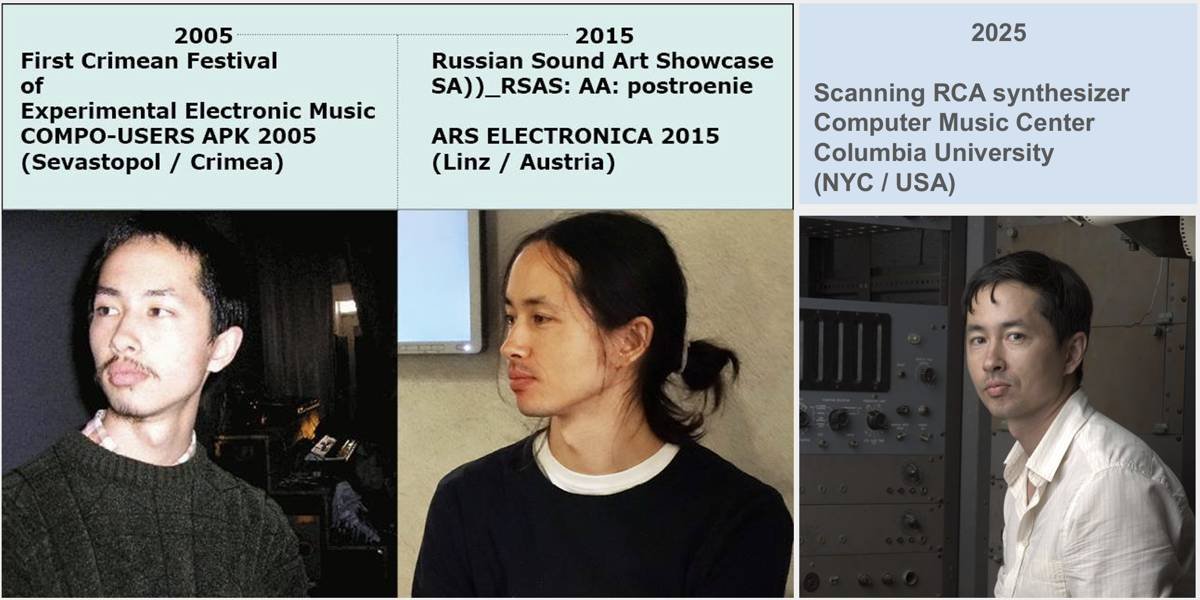
click to enlarge this illustrative picture: